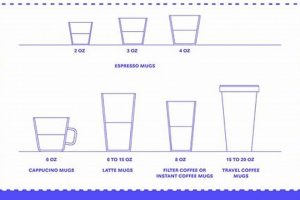
The quantity of brewed servings obtainable from a unit of coffee grounds is a common inquiry among consumers. A standard pound of coffee, containing 16 ounces by weight, yields a variable number of cups depending on the brewing method and desired strength. Generally, a tablespoon or two of ground coffee is used per six-ounce cup of water. This ratio influences the total yield from a single pound.
Understanding the yield from a pound of coffee is valuable for budgeting purposes and managing coffee consumption. Retail prices for coffee are often calculated on a per-pound basis, making the knowledge of potential yield essential for informed purchasing decisions. Historically, determining yield was a manual process, relying on estimations; modern brewing guides offer more precise measurements.
Factors impacting the final brewed volume include grind size, the type of coffee bean, and personal taste preferences. These variables are explored further to provide a comprehensive understanding of the coffee-to-water ratio and its effect on the number of servings.
Maximizing Coffee Yield from a Pound
The following tips provide guidance on optimizing the output derived from a pound of coffee, ensuring both cost-effectiveness and consistent quality.
Tip 1: Precise Measurement: Employ a kitchen scale for accurate coffee measurement. Measuring by weight, rather than volume (tablespoons), offers greater consistency and minimizes wastage. For example, consistently using 10 grams of coffee per 6-ounce cup allows for predictable yield.
Tip 2: Grind Consistency: A uniform grind size is crucial. Uneven grinds result in inconsistent extraction, wasting coffee and impacting flavor. Investing in a burr grinder ensures a consistent particle size for optimal brewing.
Tip 3: Brewing Method: Different brewing methods have varying efficiencies. French presses and pour-over methods may require a slightly coarser grind and a different coffee-to-water ratio compared to drip machines, thus affecting the overall yield.
Tip 4: Water Quality: Filtered water is recommended. Impurities in tap water can negatively affect the flavor of the coffee and potentially require the use of more coffee to achieve the desired strength. This directly impacts the number of cups obtainable.
Tip 5: Storage Practices: Store coffee beans in an airtight container away from light, heat, and moisture. Exposure to these elements degrades the beans, necessitating the use of more coffee to compensate for the diminished flavor. Proper storage maximizes the usable lifespan of the pound.
Tip 6: Adjust for Taste: Experiment with coffee-to-water ratios to find the ideal balance for the palate. Once established, consistently maintain the chosen ratio to accurately project the yield from a pound of coffee. A slight adjustment can significantly alter the final number of cups.
By implementing these techniques, individuals can better predict and manage the volume of coffee brewed from a single pound, achieving optimal flavor and minimizing waste.
Careful consideration of these factors will lead to a more economical and enjoyable coffee experience.
1. Bean Density
Bean density, a characteristic determined by factors such as coffee varietal, growing altitude, and processing method, exerts a direct influence on the potential yield obtainable from a pound of coffee beans. Denser beans contain more mass within a given volume compared to less dense beans. Consequently, a pound of denser beans will physically occupy less space and, when ground, provide a higher concentration of coffee particles for extraction. This increased concentration allows for the possibility of brewing a larger number of cups, assuming all other variables remain constant. For example, a pound of dense, high-altitude grown Arabica beans will generally produce more brewed cups than a pound of less dense Robusta beans.
The relationship between bean density and yield is not merely theoretical; it has practical implications for both coffee retailers and consumers. Retailers who understand bean density can more accurately predict inventory needs and provide informed recommendations to customers. Consumers, in turn, can make more cost-effective purchasing decisions by considering that beans with greater density, though potentially more expensive per pound, may offer a higher cup yield in the long run. It is worth considering if the price of coffee depends on bean density, there for an increased quantity can be achieved for the same price. Furthermore, roasters adjust their roasting profiles based on bean density to optimize flavor development; this, indirectly, also impacts the final yield as under-roasted or over-roasted beans necessitate adjustments in brewing ratios.
In summary, bean density is a significant determinant of brewing yield. While other factors, such as grind size and brewing method, also play critical roles, understanding the impact of bean density provides a foundational knowledge for maximizing the value derived from a pound of coffee. Awareness of bean density and its impact on yield is a crucial aspect to evaluate the overall value when buying coffee.
2. Grind Size

Grind size significantly influences the number of cups of coffee obtainable from a pound. The fineness or coarseness of the coffee grounds affects extraction efficiency, impacting both flavor and yield.
- Surface Area and Extraction Efficiency
Finer grinds offer a larger surface area for water to interact with, leading to faster and more complete extraction. However, excessively fine grinds can result in over-extraction, producing bitter flavors and potentially clogging filters. Conversely, coarser grinds have less surface area, leading to under-extraction and weak, sour coffee. The optimal grind size balances extraction efficiency with flavor quality, directly impacting the amount of coffee needed per cup and thus, the yield from a pound.
- Brewing Method Compatibility
Different brewing methods require specific grind sizes. Espresso machines demand a very fine grind to facilitate high-pressure extraction, while French presses utilize a coarse grind to prevent sediment from passing through the filter. Using an inappropriate grind size for a particular brewing method can lead to inefficient extraction, necessitating more coffee grounds to achieve the desired strength. This ultimately reduces the overall yield from a pound of coffee.
- Water Flow and Contact Time
Grind size affects the water flow rate through the coffee bed. Fine grinds impede water flow, extending contact time and increasing extraction. Coarse grinds allow water to flow rapidly, shortening contact time and reducing extraction. Controlled water flow, achieved through proper grind size, ensures optimal extraction without over- or under-extraction. Adjusting grind size in conjunction with water ratio can maximize the number of acceptable cups brewed from a pound.
- Sediment and Clarity
Grind size impacts the amount of sediment in the final brew. Finer grinds, even when properly filtered, can result in a sediment-heavy cup. Coarser grinds produce a cleaner, clearer brew. Excessive sediment can affect the perceived strength and quality of the coffee, potentially leading to the use of more coffee grounds to compensate. Maintaining proper grind size for the chosen brewing method is therefore crucial for optimizing yield.
Grind size serves as a pivotal factor in optimizing the use of coffee grounds, thereby affecting the total number of cups brewed from a single pound. A well-selected grind size, compatible with the brewing technique, ensures maximum extraction and minimum waste, ultimately enhancing the coffee-drinking experience while prolonging the life of your coffee supply.
3. Brewing Method
The selected brewing method is a primary determinant of the quantity of coffee produced from a pound of grounds. Each method exhibits unique characteristics influencing extraction efficiency and, consequently, the final yield.
- Drip Coffee Makers
Automated drip machines typically employ a medium grind and a water-to-coffee ratio of approximately 2 tablespoons per 6 ounces of water. This method offers a relatively consistent extraction, resulting in a predictable yield. However, inefficiencies, such as water remaining in the reservoir or incomplete saturation of the grounds, can slightly reduce the total number of cups obtained from a pound.
- French Press
The French press utilizes a coarse grind and full immersion, allowing for a longer contact time between the water and coffee. While this method often produces a richer, fuller-bodied brew, it also tends to be less efficient in terms of yield. A significant portion of the coffee remains absorbed within the grounds, and a coarser grind necessitates a higher volume of coffee per cup to achieve the desired strength. Consequently, a pound of coffee typically yields fewer cups when brewed using a French press compared to a drip machine.
- Pour-Over Method
The pour-over method relies on manual control of water flow and saturation, allowing for a high degree of precision in extraction. Skilled baristas can optimize the brewing process to maximize flavor and yield. However, the reliance on human technique also introduces variability. Inconsistent pouring or uneven saturation can lead to under-extraction or over-extraction, affecting the number of cups achievable from a pound of coffee.
- Espresso Machines
Espresso machines utilize finely ground coffee and high pressure to produce concentrated shots. Due to the concentrated nature of espresso, a relatively small amount of coffee is used per serving. While the initial yield from a pound of coffee may appear high in terms of shots, these shots are typically diluted with water or milk to create larger beverages. Therefore, the overall volume of consumable coffee produced from a pound, when accounting for dilution, may be comparable to other brewing methods.
The selection of a brewing method is a crucial factor influencing coffee yield from a pound. Each method’s unique extraction characteristics, water-to-coffee ratios, and brewing parameters ultimately dictate the quantity of consumable coffee obtained. Understanding these nuances enables consumers to make informed choices that align with their preferences and budgetary considerations.
4. Coffee Strength

The desired concentration of brewed coffee, or its perceived strength, significantly impacts the number of servings obtainable from a standard unit of coffee grounds. A preference for a robust, intense flavor profile necessitates a higher coffee-to-water ratio, consequently reducing the overall yield from a pound. Conversely, a milder, less concentrated brew allows for a greater number of servings, albeit with a less pronounced taste.
- Coffee-to-Water Ratio
The cornerstone of coffee strength is the proportion of ground coffee used relative to the volume of water. Using more coffee per unit of water produces a stronger brew, characterized by a more intense flavor, a fuller body, and a higher concentration of caffeine. However, this increased concentration directly reduces the potential yield. For example, if 3 tablespoons of coffee are used per 6 ounces of water for a strong brew, fewer cups can be made from a pound compared to using only 1 tablespoon for a weaker brew.
- Extraction Time
Longer extraction times, achieved through brewing methods like prolonged steeping or slow-drip techniques, can intensify the strength of the coffee. Extended contact between the water and coffee grounds allows for the extraction of a greater proportion of soluble compounds, leading to a more concentrated flavor. While this can enhance the perceived strength, it also means that less coffee is required to achieve a similar level of intensity, potentially slightly increasing the number of cups from a fixed amount of coffee for a specific taste profile, as less coffee could be used per cup.
- Grind Size Adjustment
To achieve a specific degree of coffee strength, the grind size can be adjusted in tandem with the coffee-to-water ratio. Finer grinds expose a larger surface area to the water, facilitating faster and more complete extraction. If a stronger brew is desired, a finer grind can be used, potentially requiring less coffee overall to achieve the target strength. However, excessively fine grinds can lead to over-extraction and bitter flavors, necessitating careful balance. Properly adjusting grind size can lead to fewer beans per cup if the taste profile desired can be achieved through grind adjustment.
- Tasting Profile
The individual’s preference for certain tasting notes and flavors affects brew strength. Some individuals prefer higher acidity; others prefer bitter notes. Certain compounds in the coffee bean extract in different amounts. One person may like the taste profile that results from an over-extracted bean, for example, whereas another person would find that profile unacceptable, and instead would need more beans in order to find the taste profile they are looking for.
In conclusion, the targeted strength of the brewed coffee is a fundamental factor determining the relationship between a unit of coffee grounds and the volume of consumable servings. Achieving a desired strength relies on the ability to alter the tasting profile, extraction time, coffee to water ratio, grind size adjustment, and extraction time. These factors must be considered in conjunction to attain a particular strength, and thus, an impact on the number of cups obtainable from a pound.
5. Water Ratio

The proportion of water used in relation to coffee grounds, termed the water ratio, critically determines the yield obtainable from a pound of coffee. This ratio directly influences extraction efficiency, strength, and ultimately, the number of cups produced.
- Standard Brewing Ratios
Industry standards often recommend a coffee-to-water ratio ranging from 1:15 to 1:18 (coffee weight to water weight). Adherence to these ratios provides a balanced extraction, optimizing flavor while maximizing yield. Deviations from these standards, such as using a higher water ratio (e.g., 1:20), may increase the number of cups but result in weaker coffee. Conversely, a lower water ratio (e.g., 1:12) yields fewer, stronger cups.
- Impact on Extraction
The water ratio affects the extraction of soluble compounds from the coffee grounds. An insufficient water volume leads to under-extraction, leaving desirable flavors behind and producing a sour, weak brew. An excessive water volume over-extracts the grounds, releasing undesirable bitter compounds and resulting in a thin, harsh cup. Maintaining an appropriate water ratio ensures optimal extraction, maximizing the flavor potential of the coffee while influencing the total yield.
- Brewing Method Specificity
Different brewing methods necessitate varying water ratios. Immersion methods, like the French press, typically employ a higher water ratio compared to drip methods. Espresso machines, utilizing high pressure, require a concentrated coffee-to-water ratio. These variations reflect the unique extraction characteristics of each method and their impact on the final cup. Consequently, the water ratio must be adjusted based on the selected brewing method to achieve optimal yield and flavor.
- Taste Preferences
Individual taste preferences influence the ideal water ratio. Some consumers prefer a bolder, more intense flavor, achieved through a lower water ratio. Others favor a lighter, more delicate taste, attained with a higher water ratio. Adjusting the water ratio allows consumers to customize their coffee to their specific preferences, impacting the number of cups obtainable from a pound while tailoring the taste profile.
In summary, the water ratio serves as a pivotal factor in determining the potential yield from a pound of coffee. Optimizing this ratio, while considering brewing method and individual taste preferences, is crucial for maximizing both the quantity and quality of brewed coffee.
6. Scoop Size

The volume of a coffee scoop directly influences the number of servings obtainable from a pound of coffee. Inconsistent scoop sizes introduce variability in the coffee-to-water ratio, disrupting the predicted yield. A larger scoop utilizes more coffee per serving, thereby reducing the total number of cups derivable from a standard unit. Conversely, a smaller scoop decreases the coffee quantity, increasing the potential cup count, albeit potentially at the expense of brew strength. This interplay highlights the practical significance of standardized scoop dimensions for accurate yield prediction.
For instance, if a consumer uses a scoop that is unknowingly 20% larger than the intended measurement, approximately 20% fewer cups of coffee will result from a pound. This discrepancy compounds over time, affecting budgetary planning and inventory management. Conversely, commercial coffee establishments rely on precise scoop sizes to maintain consistency in product quality and control costs. Standardized scoop sizes, calibrated to specific brewing parameters, are therefore essential for minimizing waste and maximizing the efficient use of coffee grounds. Moreover, different coffee bean densities can require scoops to be sized differently to ensure that the correct mass of coffee is used per volume. Failing to make the adjustment leads to incorrect coffee strengths for the user.
In conclusion, scoop size emerges as a critical determinant in the equation of how many cups a pound of coffee can produce. While seemingly minor, its impact on yield and consistency underscores the importance of accurate measurement and standardized practices. Challenges arise from the variability in scoop sizes available to consumers, making it essential to use scales for accurate measurement in order to minimize potential errors. This understanding links directly to broader themes of cost-effectiveness, resource management, and quality control within the coffee industry and in everyday coffee consumption.
7. Roast Level

Roast level, referring to the degree to which coffee beans are roasted, influences the mass and density of the beans, and thereby impacts how many cups of coffee can be brewed from a pound. Darker roasts undergo greater mass loss during the roasting process due to the extended exposure to heat, resulting in a lower density compared to lighter roasts. Consequently, a pound of dark roast coffee contains more volume than a pound of light roast coffee because the beans themselves are lighter. This difference in volume translates to fewer scoops by mass if a scoop is used, as the scoop will fill up more quickly due to the beans being less dense. This can result in a lower cup yield from a pound of dark roast beans.
The significance of roast level is further underscored by its effect on the soluble compounds within the coffee bean. Darker roasts, with their more developed flavors, can sometimes require less coffee by weight to achieve a desired strength compared to lighter roasts. However, this effect is often offset by the volume discrepancy; a larger scoop is generally needed to achieve the same weight of coffee grounds with a dark roast as with a light roast. Roasting also changes the cell structure, making darker roasts more brittle. These structures will break more easily and will create finer grinds, which will increase extraction and can potentially reduce bean requirements and increase yield depending on taste profile adjustments. Commercial applications, such as coffee shops, must account for roast level when calibrating their recipes to ensure consistency in cup yield and flavor.
In summary, roast level affects the number of cups obtainable from a pound of coffee primarily through its impact on bean density and mass. Darker roasts, being less dense, occupy more volume for the same weight, often leading to fewer cups per pound when measured volumetrically. This relationship is crucial to acknowledge for accurate yield estimations and cost management. Although nuances in taste also play a role, volume and density have a larger direct effect on the yield from a set unit of weight like a pound.
Frequently Asked Questions
The following addresses common inquiries regarding coffee yield from a standard unit of weight. These aim to clarify common points of confusion and promote informed decision-making.
Question 1: Does the type of coffee bean affect the yield?
Yes, different varieties of coffee beans possess varying densities. Denser beans, like some Arabica varieties, will yield more brewed coffee cups per pound compared to less dense beans, such as certain Robusta types, assuming all other variables remain constant.
Question 2: How does grind size influence the number of cups from a pound of coffee?
Grind size significantly affects extraction efficiency. A fine grind increases surface area, enabling more thorough extraction, but requires careful control to avoid over-extraction. Coarser grinds, conversely, may lead to under-extraction. The optimal grind, paired with proper brewing technique, maximizes yield.
Question 3: Is there a standard measurement for a ‘cup’ of coffee?
A standard ‘cup’ in coffee brewing typically refers to six fluid ounces (approximately 177 milliliters). However, mug sizes vary considerably. Discrepancies between the standard measure and actual mug volume introduce error into yield calculations. Careful measurement, when possible, is always recommended.
Question 4: Can storage conditions impact how many cups of coffee from a pound?
Suboptimal storage negatively affects coffee bean quality, reducing the number of cups obtainable from a pound. Exposure to air, light, heat, and moisture degrades volatile aromatic compounds and causes the beans to stale. Storing coffee in an airtight container, away from these elements, preserves freshness and extends the usable lifespan.
Question 5: Does the brand of coffee affect the coffee yield?
The brand of coffee will only affect the yield if the density, species, roast level, grind size are varied among different brands. If all of these are equal, then the brand should not matter.
Question 6: How can one consistently measure coffee grounds without a scale?
Scales are the most precise measurement tools. If scales are not available, using a standardized scoop (calibrated by weight for a specific coffee) is a reliable method. Ensure the scoop is leveled consistently to maintain uniformity in the coffee-to-water ratio and thus accurate yield per pound.
Proper storage, careful measurements and grind consideration is highly advised, to ensure that you can maximize the value of each bean and reduce loss.
Moving forward, the practical tools and calculators could provide quick references or calculations.
Determining Potential Yield
The preceding analysis has elucidated the multitude of factors influencing the quantity of brewed coffee obtainable from a standard pound. Bean density, grind consistency, brewing method selection, roast level, water ratio precision, and coffee strength preferences collectively determine the ultimate yield. Understanding these variables enables consumers and commercial entities to accurately project consumption and manage resources effectively.
Consistent application of the techniques and insights presented herein facilitates more informed purchasing decisions, minimizes waste, and optimizes the brewing process. Further refinement of these practices will continue to enhance resource utilization and ensure a consistent, high-quality coffee experience.