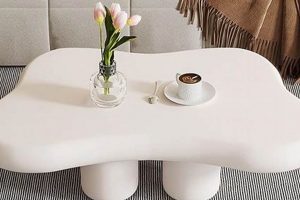
The practice of constructing a low table for beverages and other items, utilizing a cementitious composite material and employing individual craftsmanship, represents a growing trend in home decor. The process generally involves creating a mold, mixing cement with aggregates and additives, pouring the mixture into the mold, allowing it to cure, and subsequently finishing the hardened surface. An example of this involves building a wooden form, filling it with a prepared cement mix, and integrating metal legs once the concrete has sufficiently set.
This method allows for significant customization, enabling control over dimensions, shape, color, and surface texture. The inherent durability and substantial weight of the material contribute to the creation of a stable and long-lasting furniture piece. Historically, the use of concrete in furniture construction has evolved from primarily industrial applications to increasingly popular residential design elements, reflecting a broader acceptance of modern and minimalist aesthetics. Its cost-effectiveness relative to other materials and the satisfaction derived from a personally executed project are further advantages.
The following sections will explore essential considerations for successful implementation, encompassing material selection, mold construction techniques, mixing and pouring procedures, curing processes, and finishing options. Subsequent discussion will detail surface treatment strategies, design considerations for incorporating various aesthetic elements, and safety precautions necessary throughout the construction process.
Essential Considerations for Concrete Coffee Table Construction
The following provides critical guidance for crafting a durable and aesthetically pleasing low table using cementitious materials.
Tip 1: Formwork Integrity: Prioritize robust mold construction to prevent leakage during the pouring process. Seal all seams with silicone caulk and reinforce corners with bracing to maintain the intended shape. For example, use melamine-coated plywood for a smooth surface that minimizes concrete adhesion.
Tip 2: Mix Consistency: Ensure proper water-to-cement ratio for optimal strength and workability. A mix that is too dry will be difficult to pour and may result in a weak structure; a mix that is too wet can lead to excessive shrinkage and cracking. Slump tests or precise measuring are advisable.
Tip 3: Reinforcement Implementation: Integrate wire mesh or rebar to enhance the tensile strength and prevent cracking, particularly in larger table designs. Position reinforcement centrally within the concrete thickness, maintaining adequate concrete cover to prevent corrosion.
Tip 4: Vibration and Consolidation: Remove trapped air bubbles by vibrating the concrete mixture after pouring. This process ensures a dense, uniform structure. Employ a rubber mallet or a purpose-built concrete vibrator, taking care not to over-vibrate, which can cause segregation of the mix.
Tip 5: Controlled Curing: Maintain consistent moisture levels during the curing period to maximize concrete strength and minimize cracking. Cover the cast piece with plastic sheeting or damp burlap to prevent rapid evaporation. Allow at least seven days for initial curing and up to 28 days for full strength development.
Tip 6: Surface Finishing: Proper grinding and polishing are essential for achieving a smooth and aesthetically pleasing surface. Use progressively finer diamond polishing pads, starting with a coarse grit and working towards a high-gloss finish. Wet polishing methods minimize dust and improve results.
Tip 7: Sealing and Protection: Apply a concrete sealer to protect the finished surface from stains and moisture absorption. Choose a sealer appropriate for the intended use and environment. Regular application of a concrete wax can further enhance the surfaces longevity and appearance.
Adhering to these guidelines will significantly increase the likelihood of achieving a structurally sound and visually appealing furniture piece.
Considerations regarding aesthetic design and safety precautions will be addressed in subsequent sections.
1. Mixture composition

The mixture composition is a foundational element in the creation of a concrete coffee table. It directly dictates the material’s workability, strength, density, and aesthetic properties, significantly affecting the final product’s quality and longevity. The precise ratio of cement, aggregate (such as sand and gravel), water, and any added admixtures determines the consistency of the wet concrete, influencing its ability to flow into the mold and consolidate effectively. For example, a mixture deficient in water may result in a stiff, unworkable mass, precluding complete filling of the form and compromising structural integrity. Conversely, an overly wet mixture can lead to segregation of the constituents and increased shrinkage during curing, ultimately weakening the piece.
Furthermore, the type and grading of aggregate directly impact the concrete’s density, surface texture, and overall appearance. Finer aggregates contribute to a smoother surface finish, while coarser aggregates enhance structural strength and resistance to cracking. The use of specialized admixtures can modify specific characteristics, such as accelerating or retarding the setting time, enhancing workability, improving durability in freeze-thaw conditions, or introducing desired color variations. For instance, adding a pigment will alter the overall color of the table, or a plasticizer can increase flowability without increasing the water content.
Therefore, an understanding of mixture composition and its influence on the concrete’s performance is crucial for a successful outcome. The selection of appropriate materials and precise adherence to a well-formulated mix design are prerequisites for achieving a concrete coffee table that is both structurally sound and aesthetically pleasing. Neglecting this fundamental aspect can lead to a structurally unsound, aesthetically flawed, or easily damaged table, underscoring the importance of a careful mixture design.
2. Formwork Stability
Formwork stability is a critical determinant in the successful creation of a concrete coffee table. It represents the structural integrity of the mold that contains the wet concrete, shaping the final product. Any compromise in formwork stability can lead to dimensional inaccuracies, surface imperfections, and, in extreme cases, structural failure of the table.
- Dimensional Accuracy
The formwork must maintain its designed dimensions throughout the concrete pouring and curing process. Any bulging, warping, or shifting of the formwork directly translates into inaccuracies in the finished table’s size and shape. For instance, if a rectangular form bows outwards during pouring, the resulting table will have non-uniform sides and potentially uneven legs.
- Surface Texture Integrity
The inner surface of the formwork imparts its texture to the concrete. Unstable formwork may have gaps, seams, or imperfections that create corresponding flaws on the table’s surface. The form surface will directly relate to the end tables look.
- Load Bearing Capacity
The formwork must be capable of supporting the considerable weight of the wet concrete. Failure to adequately brace and reinforce the formwork can result in catastrophic collapse, leading to wasted materials, safety hazards, and the need to restart the project. Adequate load planning is very important in planning the table.
- Water Tightness
Maintaining a completely sealed form is critical to prevent water loss from the concrete mixture during curing. Water loss from the sides can degrade the end product of diy coffee table concrete.
Therefore, adequate planning and execution in formwork construction are essential to a successful diy concrete table project. The stability of the formwork directly determines the dimensional precision, surface quality, and overall structural integrity of the table, emphasizing its central role in the entire process.
3. Curing process

The curing process is a critical stage in the creation of a durable concrete coffee table. It governs the hydration of cement particles within the mixture, directly influencing the concrete’s strength, durability, and resistance to cracking. Proper management of this process is essential to achieving a final product that meets structural and aesthetic requirements.
- Hydration Rate Control
The rate at which cement hydrates dictates the development of compressive strength. Rapid moisture loss due to evaporation slows or stops hydration, leading to weaker concrete prone to surface cracking. Maintaining adequate moisture, often achieved through covering the concrete with plastic sheeting or wet burlap, ensures sustained hydration and optimal strength gain. A concrete table left to cure in direct sunlight, without any moisture retention measures, will likely exhibit reduced strength and increased surface defects.
- Temperature Management
Concrete hydration is an exothermic reaction, generating heat. Extreme temperatures, whether hot or cold, can negatively impact the curing process. High temperatures accelerate hydration but can lead to excessive shrinkage and cracking. Low temperatures, particularly freezing conditions, can halt hydration altogether and cause irreversible damage to the concrete structure. Employing insulation or controlled heating/cooling methods ensures that the concrete maintains a stable temperature range conducive to proper curing.
- Shrinkage Mitigation
Concrete undergoes volume reduction, or shrinkage, as it cures. Unrestrained shrinkage induces tensile stresses that can cause cracking, especially in large surface areas like a coffee table. Proper curing techniques, such as maintaining consistent moisture levels and using shrinkage-reducing admixtures, minimize these stresses and reduce the likelihood of cracking. A concrete table cured unevenly, where one section dries out faster than another, is more likely to crack due to differential shrinkage.
- Surface Hardness Enhancement
The surface of the concrete table is most susceptible to wear and abrasion. Proper curing practices promote a dense, hard surface that resists scratching, staining, and dusting. Ensuring consistent moisture and preventing premature drying during the initial curing phase contribute to a harder, more durable surface. A well-cured surface is thus more resistant to the wear and tear associated with normal use as a coffee table.
In essence, the curing process is not merely a passive waiting period, but an active phase requiring careful monitoring and intervention. Proper hydration, temperature control, shrinkage mitigation, and surface hardening are all facets of a successful concrete coffee table project. Attention to these details translates directly into a table that is not only structurally sound but also aesthetically pleasing and long-lasting.
4. Surface finishing

Surface finishing is an indispensable component in the construction of a concrete coffee table. The procedures applied after the concrete has cured determine the table’s final aesthetic appeal, tactile quality, and resistance to staining. Without careful surface treatment, the concrete will exhibit a rough, porous texture prone to absorbing liquids and accumulating dirt. The desired look (polished, matte) requires a defined process in diy coffee table concrete.
The finishing process typically involves a sequence of steps. Grinding with diamond-impregnated pads of progressively finer grits removes surface imperfections and achieves a desired level of smoothness. Filling any voids or air pockets with a cementitious grout ensures a uniform surface, critical for both aesthetics and functionality. Polishing further refines the surface, enhancing its reflectivity and creating a visually appealing sheen. Sealing is a final protective layer, preventing the penetration of liquids and minimizing staining. For example, a table intended for outdoor use requires a more robust sealant than one designed for indoor environments.
The choice of finishing techniques directly influences the table’s overall aesthetic. A highly polished surface offers a contemporary, elegant look, while a honed or matte finish provides a more rustic, industrial feel. The specific finishing methods also impact the table’s tactile qualities; a meticulously polished surface feels smooth and cool to the touch, while a rougher finish retains a more natural, textured feel. Ultimately, the surface finishing process is essential for transforming a raw concrete slab into a functional and visually desirable piece of furniture, bridging the gap between structural material and refined design.
5. Structural Integrity
Structural integrity, the capacity of a material to withstand applied loads without failure, is paramount in the construction of a concrete coffee table. A poorly constructed table, lacking adequate structural integrity, will be prone to cracking, deformation, and eventual collapse, rendering it unusable. Therefore, careful attention to design, material selection, and construction techniques is essential to ensure a stable and enduring piece of furniture.
- Reinforcement Strategies
The implementation of reinforcement, typically in the form of steel rebar or wire mesh, significantly enhances the tensile strength of concrete. Concrete, inherently strong in compression but weak in tension, requires reinforcement to resist bending and tensile forces induced by loads placed on the table surface. For example, without reinforcement, a large concrete table could crack under its own weight or when objects are placed on it. The type, placement, and amount of reinforcement must be carefully calculated based on the table’s dimensions and anticipated load.
- Mix Design Optimization
The concrete mix design, encompassing the proportions of cement, aggregate, water, and admixtures, directly influences its strength and durability. A properly proportioned mix achieves optimal workability for pouring, ensures adequate hydration of the cement, and minimizes shrinkage, all of which contribute to the concrete’s overall structural performance. Using an inappropriate water-cement ratio can lead to a weakened structure, susceptible to cracking and spalling. Attention must be given to selection of aggregate and cement type as well.
- Formwork Rigidity and Stability
The formwork, serving as a mold for the wet concrete, must be sufficiently rigid and stable to maintain the intended shape and dimensions of the table during pouring and curing. Any deformation or instability in the formwork can lead to structural weaknesses in the finished product. For instance, a form that bows outward under the weight of the concrete will result in a table with uneven surfaces and potentially compromised load-bearing capacity. Proper bracing and reinforcement of the formwork are thus essential.
- Curing Process Management
The curing process, involving the controlled hydration of cement, is vital for achieving the desired strength and durability of the concrete. Maintaining adequate moisture and temperature during curing allows the concrete to develop its full strength potential and reduces the risk of cracking. Premature drying or exposure to extreme temperatures can disrupt the hydration process, leading to a weaker and less durable structure. Covering the poured concrete with plastic or using wet burlap can improve this issue during the curing process.
These interconnected facets underscore the critical role of structural integrity in the successful creation of a concrete coffee table. Neglecting any one of these elements can compromise the overall stability and longevity of the table. Prioritizing structural considerations during design and construction ensures a functional and enduring piece of furniture capable of withstanding the demands of everyday use.
Frequently Asked Questions
The following addresses common inquiries and misconceptions regarding the construction of low tables using cementitious materials, intended to provide clarity and guidance for prospective builders.
Question 1: What is the minimum thickness recommended for a concrete coffee table top to ensure structural stability?
A minimum thickness of 1.5 to 2 inches is generally recommended for concrete table tops. However, this dimension depends on the table’s overall size and intended load. Larger tables require greater thickness and reinforcement to prevent cracking. Consultation with structural engineers is recommended for oversized projects.
Question 2: What type of concrete mix is best suited for a table project?
A high-strength concrete mix with a low water-to-cement ratio is optimal. A mix containing pozzolanic materials enhances durability and reduces permeability. Pre-blended concrete mixes designed for countertops or furniture are commercially available and offer consistent performance.
Question 3: How can air bubbles be effectively removed from the concrete after pouring?
Vibration is the most effective method for removing entrapped air. This can be achieved using a concrete vibrator, either internal or external. Tapping the sides of the mold with a rubber mallet can also assist in releasing trapped air. Over-vibration should be avoided as it can cause segregation of the mix.
Question 4: Is reinforcement necessary for all concrete coffee table projects?
Reinforcement is highly recommended, particularly for larger tables or those with thinner sections. Wire mesh or rebar increases tensile strength and prevents cracking. The amount and placement of reinforcement depend on the table’s design and anticipated load.
Question 5: What type of sealer should be used to protect the concrete surface?
A penetrating concrete sealer that is resistant to stains, moisture, and chemicals is recommended. Options include acrylic sealers, epoxy sealers, and siloxane-based sealers. The specific choice depends on the table’s intended use and exposure conditions. Regular reapplication is necessary to maintain protection.
Question 6: How long should the concrete cure before removing the formwork?
A minimum of 7 days is recommended before removing the formwork. However, allowing the concrete to cure for 28 days will result in greater strength and durability. The curing process should be conducted in a controlled environment with consistent moisture and temperature.
In summary, successful implementation of a diy concrete table requires careful consideration of mix design, reinforcement, vibration, curing, and sealing. Adherence to these principles is crucial for producing a durable and aesthetically pleasing piece of furniture.
The subsequent section will address advanced design considerations for incorporating unique aesthetic elements into your project.
Conclusion
The preceding discussion has explored essential considerations for successful low table construction using cementitious materials. Key aspects, including mixture composition, formwork stability, curing processes, surface finishing techniques, and structural integrity, have been examined in detail. This synthesis underscores the multifaceted nature of the undertaking, emphasizing the need for both meticulous planning and precise execution.
The pursuit of crafting one’s own low table from cement represents a commitment to both functional design and personalized artistry. Diligent application of the outlined principles will yield a durable, aesthetically pleasing furniture piece, a tangible testament to individual craftsmanship. Future endeavors should focus on further refinement of techniques, exploration of innovative material combinations, and adherence to rigorous standards to maximize the value and longevity of these constructed pieces.