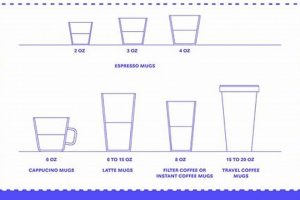
These vessels are specifically designed for the practice of coffee quality assessment, also known as coffee cupping. Typically made of ceramic or glass, they hold a precise volume of brewed coffee, allowing for standardized evaluation. Their shape, often a wide-mouthed cylinder, facilitates aroma capture and easy access for sensory analysis using a spoon.
Consistent cup design is crucial for reliable cupping results. Uniformity in size, material, and shape minimizes variations that could influence the taster’s perception of aroma, flavor, and body. This standardization aids in objective comparisons between different coffee samples and contributes to fair and accurate quality grading. Historically, using designated vessels has helped establish cupping as a widely accepted industry standard.
The following sections will detail the ideal materials, dimensions, and maintenance procedures for optimal cupping results. Furthermore, a discussion on the evolution of cup design and its impact on coffee evaluation will be explored. The proper use and handling of these essential tools play a vital role in ensuring the integrity of the cupping process and the accuracy of coffee quality assessment.
Optimizing Coffee Cupping with Standardized Vessels
Employing the correct methodology with appropriate cupping vessels ensures the integrity of coffee evaluation. These guidelines enhance accuracy and consistency in sensory analysis.
Tip 1: Select Ceramic or Glass. These materials are inert, preventing any alteration of the coffee’s flavor profile. Avoid plastics or metals that could impart unwanted tastes.
Tip 2: Maintain a Consistent Volume. Use vessels that consistently hold the same volume, typically around 200-250 ml. This standardization allows for objective comparisons between samples.
Tip 3: Ensure a Wide Mouth. The wide opening facilitates aroma evaluation, allowing for optimal capture and perception of volatile compounds released from the coffee.
Tip 4: Preheat Before Use. Warming the vessels before pouring the brewed coffee helps to maintain a consistent temperature, influencing the perceived flavor and aroma.
Tip 5: Inspect for Cracks or Chips. Damaged vessels can affect the cupping process by either leaking or potentially altering the flavor due to the exposed material. Regularly inspect before each session.
Tip 6: Clean Thoroughly After Each Use. Residual oils and coffee particles can contaminate subsequent cupping sessions. Use a non-fragranced detergent and rinse thoroughly.
Tip 7: Standardize Cup Color. Using uniformly colored vessels, typically white or light neutral tones, eliminates visual bias and focuses the evaluator on the coffee’s sensory attributes.
Adhering to these practices minimizes variables, promoting a more reliable and objective evaluation of coffee quality. Consistent application is critical for informed decision-making within the coffee industry.
The subsequent section will address the practical application of these guidelines within a professional cupping environment.
1. Material Composition

The material composition of cupping vessels significantly impacts the integrity of coffee sensory evaluation. The primary function of these containers is to hold brewed coffee without altering its inherent characteristics. Therefore, inert materials such as ceramic and glass are preferred. These materials resist chemical reactions with the coffee, preventing the introduction of foreign flavors or odors that could skew the cupping results. Conversely, materials like some plastics or metals can leach compounds into the coffee, contaminating the sample and rendering the evaluation invalid. For example, using a metallic cup might impart a metallic taste, masking the subtler nuances of the coffee’s profile.
Ceramic offers good heat retention, aiding in maintaining a stable temperature during the evaluation period, and is readily available. However, the glazing used on ceramic can sometimes introduce undesirable scents if not properly fired and cured. Glass provides a truly neutral surface, allowing for purely unadulterated flavor profiles. It also permits visual inspection of the coffee’s clarity. Its primary disadvantage lies in lower thermal stability compared to ceramic. The choice of material must, therefore, balance these considerations, prioritizing neutrality and minimizing potential sources of external influence.
The industrys insistence on inert materials is a direct response to past instances of compromised evaluations. The careful selection of vessel material underscores the commitment to objective and accurate coffee quality assessment, ensuring that evaluations are focused on the coffee’s origin and processing, and not on artifacts introduced by unsuitable cupping equipment. The composition must therefore be considered a foundational requirement for reliable sensory analysis.
2. Volume Standardization

Volume standardization is a critical component in ensuring reliable and repeatable results during coffee cupping. The cupping process relies on consistency to accurately assess and compare different coffee samples. The volume of the vessel directly affects the coffee-to-water ratio during brewing, a variable that significantly influences extraction and perceived flavor. If volumes are inconsistent, the resulting brews will have varying concentrations of soluble compounds, leading to skewed sensory perceptions and invalid comparisons. For instance, a cup with a lower volume will produce a more concentrated brew, potentially exaggerating attributes like bitterness or body, while a higher-volume cup will produce a weaker brew, potentially diluting flavor nuances.
The practical application of volume standardization involves selecting vessels of precisely measured capacity, typically in the range of 200-250 ml. Many professional cupping labs utilize specialized equipment to accurately measure liquid volumes and ensure that each vessel contains the identical amount of brewed coffee. This meticulous approach minimizes inconsistencies due to human error and further reduces variability. Furthermore, adhering to specified brewing ratios alongside volume standardization ensures that all samples are prepared using the same proportions. A failure to maintain uniform volume negates other standardized cupping parameters such as grind size and brewing time, rendering the overall evaluation process less objective.
Therefore, volume standardization is not merely a trivial detail but rather a fundamental requirement for scientific rigor in coffee cupping. It forms the foundation upon which sensory assessments are based, allowing for fair and meaningful comparisons. Challenges to achieving perfect standardization persist due to manufacturing tolerances of the vessels themselves, requiring careful selection and verification processes. Ultimately, prioritizing volume standardization contributes to more informed decision-making within the coffee industry, supporting transparency and quality control throughout the supply chain.
3. Thermal Stability

Thermal stability in coffee cupping vessels refers to the ability of the cup to maintain a consistent temperature of the contained coffee over the duration of the evaluation period. This is a crucial factor because temperature directly influences the volatility of aromatic compounds and thus affects the sensory perception of the coffee. Fluctuations in temperature can cause certain aromas to diminish or become more pronounced, leading to inaccurate assessment of the coffee’s true flavor profile. For instance, a rapid temperature drop might suppress the perception of delicate floral notes, while excessively high temperatures can accentuate bitterness and acidity. Therefore, the thermal properties of the cupping vessel are not merely incidental; they are integral to ensuring a level playing field for sensory analysis.
Materials with high thermal mass, such as thicker ceramic, are generally favored because they resist temperature changes more effectively than thinner materials like glass. While glass offers excellent inertness, its lower thermal mass can result in quicker temperature decline, especially in cooler environments. The impact of this is observable in professional cupping scenarios where meticulous baristas often preheat the cupping vessels before pouring the brewed coffee. This preheating compensates for the heat loss to the vessel itself, minimizing initial temperature shock and extending the period of thermal stability. Furthermore, ambient conditions within the cupping room must be carefully controlled, as drafts or temperature fluctuations can exacerbate thermal instability in the cups, influencing cupping outcomes.
In conclusion, thermal stability is not simply a desirable attribute of coffee cupping vessels but a fundamental necessity for reliable sensory evaluation. It minimizes temperature-related variations that can distort aroma perception, ensuring that assessments are focused on the intrinsic qualities of the coffee. Challenges in achieving perfect thermal stability, particularly in diverse environmental conditions, necessitate careful material selection, preheating protocols, and environmental controls. The pursuit of optimal thermal stability in cupping demonstrates the commitment to objective and accurate assessment, underlining the importance of this often-overlooked component in the coffee industry.
4. Shape Optimization

Shape optimization in coffee cupping vessels directly influences the accuracy and consistency of sensory analysis. The design dictates how effectively volatile aromatic compounds are captured and delivered to the evaluator’s olfactory system. A wider opening, for example, facilitates greater aroma release, allowing for a more comprehensive assessment of the coffee’s fragrance and bouquet. Conversely, a narrow opening may restrict aroma dispersion, potentially masking subtle nuances and leading to an incomplete evaluation. The internal curvature of the cup can also impact aroma circulation; a well-designed curvature promotes uniform distribution of the aroma above the liquid surface.
The standardized cylindrical shape commonly employed in cupping protocols is a deliberate choice. This geometry offers a balance between maximizing surface area for aroma release and minimizing heat loss. It also provides easy access for the cupping spoon, allowing for efficient sampling and evaluation of the coffee’s body and flavor. Deviation from this standardized shape can introduce variables that compromise the objectivity of the cupping process. For instance, a cup with a tapered bottom might lead to inconsistent settling of sediment, affecting the perceived texture and clarity. Similarly, a cup with an excessively deep profile may hinder aroma perception, as the evaluator must lean further into the vessel to capture the full aromatic spectrum. The shape is a crucial element dictating airflow, sediment deposit, and aroma volatility.
In conclusion, shape optimization is not an arbitrary design consideration but a functional imperative for reliable coffee cupping. The shape’s influence on aroma capture, heat retention, and ease of use necessitates a careful and standardized approach. The cylindrical form serves as a benchmark for objective assessment, ensuring that evaluations are based on the coffee’s intrinsic qualities rather than artifacts introduced by suboptimal vessel design. Future research into alternative shapes may yield further improvements, but any such modifications must be rigorously tested to ensure they enhance, rather than compromise, the accuracy and consistency of the cupping process. Shape directly and indirectly determines whether the aroma will linger on the nose for a good long while, or a shorter time, which impacts grading.
5. Cleanliness Protocol
The cleanliness protocol surrounding coffee cupping vessels is a critical component for achieving objective and reliable sensory evaluations. Residual coffee oils and particulate matter adhering to these vessels can introduce extraneous flavors and aromas, thus contaminating subsequent cupping sessions. The presence of even minute traces of previous coffees can significantly alter the perceived attributes of the current sample, undermining the integrity of the evaluation. For example, a subtle hint of a previous robusta sample lingering in the cup can erroneously influence the perceived bitterness or earthiness of a high-quality arabica being evaluated. Without strict adherence to a comprehensive cleanliness protocol, cross-contamination becomes a significant threat, invalidating comparative assessments and leading to inaccurate conclusions about coffee quality.
A robust cleanliness protocol typically involves a multi-stage process. Initially, used cups are thoroughly rinsed to remove loose coffee grounds. This is followed by washing with a non-fragranced detergent specifically designed to remove coffee oils. Scented detergents can themselves leave residue, further affecting sensory evaluation. After washing, cups undergo a meticulous rinsing process, preferably with filtered water, to ensure all traces of detergent are eliminated. In some professional cupping environments, a final sanitizing step, using food-grade sanitizers, is implemented to further minimize the risk of contamination. Cups are then air-dried on designated racks to prevent the accumulation of moisture, which can promote the growth of mold and bacteria. The effectiveness of this protocol is regularly monitored through periodic quality control checks, including sensory evaluation of blank water samples cupped in the cleaned vessels.
In summary, a rigorous cleanliness protocol is not merely a procedural detail but a fundamental requirement for maintaining the validity of coffee cupping. Its absence directly compromises the objectivity of sensory evaluations, leading to potentially flawed assessments of coffee quality. The consistent and meticulous implementation of a comprehensive cleaning regime minimizes the risk of cross-contamination, ensuring that cupping results accurately reflect the inherent qualities of the evaluated coffee samples. The connection between cleanliness and objective sensory evaluation is thus undeniable and underscores the commitment to scientific rigor within the coffee industry. Clean cups are critical to clear assessments.
6. Color Neutrality

Color neutrality in coffee cupping vessels represents a deliberate effort to minimize visual bias during sensory evaluation. The color of the cup should not influence the evaluator’s perception of the coffee’s characteristics, focusing attention solely on aroma, flavor, and body. This principle is paramount for objective assessment.
- Minimizing Psychological Influence
Colored cups can unconsciously prime evaluators, influencing their expectations and potentially skewing their judgment. For instance, a reddish cup might subtly amplify the perceived intensity of fruity notes, while a blue cup might enhance the perception of acidity, independent of the coffee’s actual attributes. Using neutral colors eliminates these subconscious cues, fostering a more unbiased evaluation.
- Standardizing Visual Appearance
Consistent cup color across all samples promotes a standardized visual appearance, reducing variability in the cupping environment. This consistency allows evaluators to focus on the coffee itself, rather than being distracted by differences in cup aesthetics. Uniformity supports accurate comparison across various samples and from one session to the next.
- White as the Predominant Standard
White is the most common color choice for cupping vessels due to its high reflectivity and lack of inherent color bias. It provides a neutral backdrop for assessing the coffee’s color, crema, and clarity, all of which can provide subtle clues about its quality and origin. White also minimizes the potential for color cast or light absorption, ensuring that the coffee’s visual attributes are accurately perceived.
- Alternative Neutral Tones
While white is the standard, other light neutral tones, such as light gray or beige, may also be employed. The key criterion is the absence of strong pigmentation that could potentially influence the evaluator’s perception. These alternative tones should possess similar reflective properties to white, minimizing any potential bias in visual assessment.
These considerations underscore the significance of color neutrality in the design and selection of vessels. By prioritizing neutral colors, the cupping process maintains objectivity, ensuring the sensory evaluation is based solely on the intrinsic qualities of the coffee. Color neutrality highlights the rigorous approach to objective sensory assessment.
Frequently Asked Questions
The following addresses common inquiries and clarifies essential aspects of vessels designed for coffee cupping protocols. Understanding these points promotes effective cupping practices.
Question 1: Why are specialized vessels necessary for coffee cupping?
Specialized vessels ensure standardization, which is crucial for objective sensory evaluation. Consistent material, volume, and shape minimize variables that can influence aroma, flavor, and body perception. This facilitates accurate comparisons between different coffee samples.
Question 2: What materials are considered acceptable for coffee cupping vessels, and why?
Ceramic and glass are generally considered acceptable materials due to their inertness. These materials are unlikely to react with the coffee, preventing the introduction of foreign flavors or odors that could skew the evaluation. Avoidance of reactive materials such as certain metals is essential.
Question 3: What is the standard volume for coffee cupping vessels, and how does it affect the process?
The standard volume typically ranges from 200 to 250 ml. Maintaining a consistent volume ensures a standardized coffee-to-water ratio during brewing, which directly impacts extraction and perceived flavor. Volume variations can lead to inconsistent sensory results.
Question 4: How does the shape of the cupping vessel influence the sensory evaluation?
The shape, particularly the width of the opening, influences aroma capture and delivery. A wider opening facilitates greater aroma release, allowing for a more comprehensive assessment of the coffee’s fragrance. The internal curvature also impacts aroma circulation.
Question 5: What cleaning procedures are essential for maintaining coffee cupping vessels?
A rigorous cleaning protocol is essential to prevent cross-contamination. Used vessels should be thoroughly rinsed, washed with a non-fragranced detergent, and rinsed again to remove all detergent residue. Sanitization and air-drying are also recommended.
Question 6: Why are coffee cupping vessels typically white or a light neutral color?
Color neutrality minimizes visual bias during sensory evaluation. Colored vessels can subconsciously influence the evaluator’s expectations, potentially skewing their judgment of the coffee’s characteristics. White offers a neutral backdrop for visual assessment.
Proper utilization and maintenance of coffee cupping vessels, therefore, contributes significantly to the accuracy and reliability of coffee quality assessment within the industry.
In the subsequent section, expert opinions on selecting optimal vessels for consistent and effective sensory evaluation are considered.
Coffee Cupping Cups
The preceding exploration has detailed the critical role of standardized vessels in coffee cupping. Precise control over material, volume, shape, cleanliness, and color contributes directly to the accuracy and reliability of sensory evaluation. The consistent application of these principles minimizes extraneous variables, allowing for an objective assessment of coffee quality, which is essential for informed decision-making throughout the industry.
Continued adherence to established protocols, coupled with ongoing research into optimal vessel design, will further refine the cupping process. By prioritizing the standardization of “coffee cupping cups,” the industry strengthens its commitment to quality, transparency, and consumer satisfaction. The integrity of this practice hinges on the unwavering dedication to objective assessment, ensuring that evaluations reflect the true characteristics of the coffee under scrutiny.