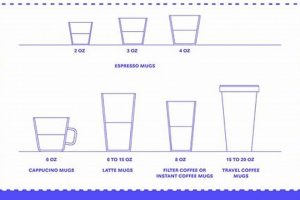
A three-dimensional representation of a container designed for holding coffee involves digital modeling techniques. Such models allow for a complete visualization of the object’s form, including its curves, textures, and overall design aesthetics. For example, these models can be used to create photorealistic images for marketing purposes or generate files suitable for 3D printing prototypes.
The importance of these representations lies in their ability to streamline the design and manufacturing process. By visualizing the object in three dimensions, potential design flaws can be identified and rectified before physical production begins. This can lead to significant cost savings and reduced waste. Historically, designers relied on sketches and physical prototypes, but advanced modeling software now offers greater precision and flexibility.
The following sections will delve into the specific applications of creating these virtual objects, exploring topics such as design software options, rendering techniques, and the role of these models in product visualization and prototyping. We will also examine the impact on manufacturing workflows and the potential for customized designs.
Tips for Utilizing Three-Dimensional Coffee Cup Models
This section provides practical guidance for effectively using three-dimensional models of coffee containers in various design and manufacturing applications.
Tip 1: Accurate Measurement Implementation: When designing, prioritize precise measurements reflective of real-world specifications. Discrepancies in dimensions can lead to manufacturing errors or incompatibility with intended accessories, such as lids or sleeves.
Tip 2: Material Properties Considerations: Simulate realistic material properties within the digital model. Factors like thermal conductivity, texture, and transparency will impact the rendered appearance and inform manufacturing decisions regarding material selection.
Tip 3: Optimize Mesh Density for Intended Use: Balance detail and file size by adjusting the mesh density appropriately. High-resolution models are necessary for photorealistic renderings, but lower-resolution models are sufficient for 3D printing prototypes and AR/VR applications.
Tip 4: Incorporate Ergonomic Principles: Design for user comfort by integrating ergonomic principles into the container’s shape and handle design. This includes considerations for grip size, weight distribution, and ease of handling.
Tip 5: Ensure Printability and Manufacturability: If the model is intended for 3D printing, check for overhangs and unsupported areas that may require supports. In addition, assess its suitability for mass production methods, such as injection molding.
Tip 6: Texturing and Surface Detailing: Implement detailed textures and surface finishes to enhance realism and visual appeal. Proper texturing can simulate the appearance of various materials and add intricate design elements.
The application of these tips can significantly improve the efficiency and effectiveness of design workflows, reduce manufacturing costs, and enhance the overall quality of the final product.
The subsequent section will explore specific software options available for creating and manipulating these models, providing insights into selecting the right tools for various design needs.
1. Design Aesthetics

Design aesthetics in relation to three-dimensional models of coffee containers encompasses the visual appeal and stylistic elements that contribute to the overall user experience. It directly influences consumer perception and brand identity, necessitating careful consideration during the design process.
- Form and Silhouette
The overall shape and outline of the coffee container are paramount. Curvature, symmetry, and proportions all contribute to its aesthetic appeal. For example, a sleek, minimalist form can project a sense of modernity, while a more traditional silhouette may evoke a feeling of warmth and familiarity. The form influences how the cup interacts with the hand and the eye, and can affect the perceived value of the product.
- Surface Texture and Finish
The texture and finish of the container’s surface play a crucial role in tactile and visual experience. A smooth, glossy finish may convey elegance, while a textured or matte finish can communicate robustness and practicality. Embossed or debossed patterns can add visual interest and enhance grip. Material selection also impacts the surface properties and its perceived quality, ranging from the clean lines of ceramics to the rugged feel of recycled materials.
- Color Palette and Branding
The color scheme employed on the container directly impacts its visual appeal and brand recognition. Colors can evoke emotions and associations, and should be carefully selected to align with the brand’s identity and target audience. The strategic placement of logos, graphics, and other branding elements contributes to brand visibility and differentiation. The careful balance of color and branding elements enhance the perception of the model.
- Visual Weight and Balance
The distribution of visual elements, such as handles, ridges, or embellishments, affects the overall balance and harmony of the design. Asymmetric designs can create a dynamic and modern aesthetic, while symmetrical designs provide a sense of stability and tradition. Understanding visual weight ensures that the design feels balanced and visually pleasing, contributing to a positive user experience.
In summary, design aesthetics in the context of three-dimensional coffee container models extends beyond mere visual appeal. It encompasses a complex interplay of form, texture, color, and balance that collectively shapes the user’s perception and interaction with the product. Effective aesthetic design considers how each of these elements contributes to the overall brand identity and user experience.
2. Material Simulation

Material simulation within the design and development of three-dimensional coffee cup models involves digitally replicating the physical properties of real-world materials. This process is crucial for predicting product performance, optimizing design parameters, and ensuring manufacturability. Accurate simulation minimizes the need for costly physical prototypes and reduces time-to-market.
- Thermal Conductivity Analysis
Thermal conductivity analysis assesses how efficiently a material transfers heat. For coffee containers, this determines how well the cup insulates, maintaining beverage temperature and protecting the user’s hand. Simulation allows designers to test different materials and wall thicknesses, optimizing for heat retention and user comfort. For example, a double-walled ceramic design with a vacuum gap can significantly reduce heat transfer compared to a single-walled design. Inaccurate material simulation leads to unexpected user burns, lukewarm beverages, and dissatisfied customers.
- Structural Integrity Assessment
Structural integrity assessment examines the material’s ability to withstand stress and strain. This is critical for ensuring the coffee cup can endure repeated use, washing, and potential impacts without cracking or breaking. Simulation enables engineers to identify weak points in the design and optimize the geometry or material selection for increased durability. A glass design, for example, would need careful stress analysis at the handle attachment point to prevent breakage. Neglecting structural integrity assessment results in product failures, warranty claims, and damage to brand reputation.
- Texture and Surface Properties
Texture and surface properties influence grip, aesthetics, and cleanability. Material simulation provides a means of visualizing and evaluating different surface finishes and textures. For instance, a textured surface can improve grip and reduce the likelihood of spills, while a smooth surface simplifies cleaning. Simulation allows designers to preview the visual appearance of different materials, enabling informed decisions about aesthetics. Improper evaluation of surface properties leads to slippery surfaces, difficulty in cleaning, and ultimately, a less desirable product.
- Weight Optimization
Weight optimization focuses on minimizing material usage while maintaining required structural performance. Simulation assists in identifying areas where material can be removed without compromising integrity. Reducing weight translates to lower material costs, reduced shipping expenses, and a more comfortable user experience. For example, a plastic cup design can be optimized by adding ribs for reinforcement while reducing wall thickness in less stressed areas. Inefficient weight management results in increased material costs and heavier, less ergonomic products.
In conclusion, material simulation is integral to creating effective three-dimensional models of coffee cups. The precise simulation of thermal, structural, surface, and weight properties leads to optimized designs, reduced development costs, and enhanced product performance. Failure to properly simulate materials can lead to functional failures, aesthetic shortcomings, and ultimately, consumer dissatisfaction.
3. Ergonomic Integration

Ergonomic integration within the design of three-dimensional coffee cups involves the application of human factors principles to optimize user comfort, safety, and efficiency. The shape, size, and texture of the cup are tailored to fit the human hand, reducing strain and fatigue during use. A poorly designed cup can lead to discomfort, spills, and even repetitive strain injuries. For example, a cup with a handle that is too small or positioned awkwardly can cause hand cramps, while a cup that is too heavy can lead to wrist strain. The integration of ergonomic principles is therefore not merely an aesthetic consideration but a functional imperative, contributing directly to user satisfaction and product safety.
Several practical considerations are crucial in ergonomic design. Handle size and shape must accommodate a range of hand sizes. The material and surface finish should provide adequate grip, even when the cup is wet. The cup’s weight and balance must be carefully managed to minimize strain on the user’s wrist and forearm. Further, the cup’s shape should facilitate easy pouring and drinking, minimizing the risk of spills. A real-world example of successful ergonomic integration is the design of certain travel mugs that feature contoured grips and non-slip surfaces, significantly enhancing usability and reducing the likelihood of accidents. The use of digital modeling enables designers to simulate different hand positions and grip strengths, optimizing the design for a broad range of users.
In summary, ergonomic integration is an essential component in the design of effective three-dimensional coffee cups. Its significance extends beyond mere comfort, encompassing safety, efficiency, and overall user satisfaction. While challenges exist in accommodating diverse user needs and preferences, the application of human factors principles, combined with the capabilities of 3D modeling and simulation, enables the creation of coffee cups that are both aesthetically pleasing and functionally superior. Neglecting ergonomic considerations can result in products that are uncomfortable, unsafe, and ultimately, less desirable to consumers.
4. Prototyping Accuracy
Prototyping accuracy, in the context of three-dimensional coffee cup design and manufacturing, refers to the degree to which a physical prototype replicates the digital model. A high level of accuracy ensures that the physical properties, dimensions, and aesthetic details of the prototype closely match the intended design. This is crucial because discrepancies between the digital model and the physical prototype can lead to costly design iterations, manufacturing errors, and ultimately, a product that fails to meet functional or aesthetic requirements. For example, if the prototype’s handle is not correctly sized or positioned, it can lead to discomfort or instability, necessitating a redesign. Conversely, if the prototypes surface texture differs substantially from the digital rendering, the final product may not align with the intended brand image. Accurate prototyping therefore serves as a critical validation step in the design process, enabling engineers and designers to identify and correct any issues before committing to mass production.
Several factors contribute to achieving high prototyping accuracy. These include the precision of the 3D printing or manufacturing technology used to create the prototype, the accuracy of the materials used, and the skill of the technicians involved in the prototyping process. Additive manufacturing techniques, such as stereolithography or selective laser sintering, can achieve a high degree of dimensional accuracy, allowing for the creation of intricate details and complex geometries. Material selection is also important; the chosen material should closely mimic the properties of the material intended for final production to ensure that the prototype behaves realistically. Furthermore, post-processing techniques, such as sanding, polishing, or painting, can be used to refine the prototype’s surface finish and aesthetic appearance, further enhancing its realism. Prototyping for a ceramic cup, for example, would require a different process, expertise, and attention to glazing than a plastic cup’s prototype.
In conclusion, prototyping accuracy is an indispensable aspect of three-dimensional coffee cup development. It bridges the gap between digital design and physical reality, allowing engineers and designers to evaluate and refine their designs before committing to full-scale production. Challenges exist in achieving high accuracy, particularly with complex geometries or unusual materials, but the benefits of reducing design iterations, minimizing manufacturing errors, and ensuring product quality make prototyping accuracy a crucial investment in the development process. It ensures the final product is not only aesthetically pleasing but also functional, durable, and safe for its intended use, fulfilling the brand’s promise and meeting consumer expectations.
5. Manufacturing Feasibility

Manufacturing feasibility, in the context of three-dimensional coffee cup design, represents the assessment of whether a proposed design can be realistically and economically produced using available manufacturing processes. This assessment considers factors such as material properties, geometric complexity, production volume, and cost constraints. The impact of manufacturing feasibility is direct: a design that is aesthetically appealing but impractical to mass produce will remain a concept, unable to reach the market. The integration of manufacturing considerations early in the design phase is critical to prevent wasted resources on designs that are inherently unproducible. For example, a cup design featuring intricate internal geometries may be achievable through 3D printing, but the cost per unit would likely be prohibitive for widespread consumer adoption. Similarly, a design that requires extremely tight tolerances may necessitate specialized tooling and quality control processes, significantly increasing manufacturing costs.
Real-world examples illustrate the practical significance of considering manufacturing feasibility. Consider the common injection-molded plastic cup. Its design is carefully optimized for ease of manufacturing, featuring draft angles to facilitate part ejection, uniform wall thicknesses to prevent warping, and strategically placed ribs for structural reinforcement. These design elements, often subtle and unnoticed by the end-user, are crucial for ensuring that the cups can be produced quickly, reliably, and at a low cost. Conversely, designs that disregard these principles often encounter problems such as incomplete mold filling, excessive material waste, or unacceptably high reject rates. The evaluation of manufacturing feasibility also extends to the choice of materials, considering factors such as availability, cost, and recyclability. A design that specifies a rare or expensive material may be commercially unviable, even if it possesses superior performance characteristics.
In summary, manufacturing feasibility is a vital consideration in the development of three-dimensional coffee cups. Its impact spans from design conceptualization to production execution, influencing cost, quality, and overall market viability. Addressing manufacturing constraints early in the design process mitigates risks, reduces development time, and ensures that the final product is both aesthetically pleasing and practically producible. Effective integration of manufacturing considerations transforms a mere concept into a tangible product that can meet market demand and achieve commercial success.
Frequently Asked Questions About 3D Coffee Cup Modeling
This section addresses common inquiries related to the design, application, and manufacturing aspects of three-dimensional models of coffee containers. The information provided aims to clarify technical aspects and practical considerations.
Question 1: What level of detail is typically required for a three-dimensional coffee cup model?
The required level of detail depends on the intended use. For photorealistic renderings or marketing materials, a high level of detail, including intricate textures and surface finishes, is necessary. For prototyping or initial design validation, a lower level of detail may suffice to capture the overall shape and dimensions.
Question 2: What software is commonly used to create three-dimensional coffee cup models?
Various software options are available, including CAD (Computer-Aided Design) software like SolidWorks, Fusion 360, and AutoCAD, as well as sculpting software like Blender and ZBrush. The choice depends on the designer’s preferences, the complexity of the design, and the intended application.
Question 3: How can material properties be accurately simulated in a three-dimensional coffee cup model?
Material properties can be simulated using rendering engines and material libraries within the modeling software. These tools allow designers to specify parameters such as thermal conductivity, surface roughness, and reflectance, influencing the visual appearance and simulated performance of the model.
Question 4: What are the common challenges encountered when creating three-dimensional coffee cup models for 3D printing?
Common challenges include ensuring printability, addressing overhangs and unsupported areas, and optimizing the model for the chosen printing technology. Support structures may be required to prevent deformation during printing, and the model’s orientation must be carefully considered to minimize print time and material usage.
Question 5: How does ergonomic design influence the creation of three-dimensional coffee cup models?
Ergonomic considerations drive the shape, size, and placement of features such as handles. Designers may utilize human factors data and simulation tools to optimize the cup for user comfort, grip, and ease of handling, reducing the risk of strain or spills.
Question 6: How can manufacturing feasibility be assessed during the design phase of a three-dimensional coffee cup model?
Manufacturing feasibility can be assessed by considering factors such as draft angles, wall thicknesses, and moldability. Consulting with manufacturing experts and utilizing design for manufacturability (DFM) tools can help identify potential production challenges and optimize the design for efficient and cost-effective manufacturing.
The key takeaways from these FAQs emphasize the necessity of balancing aesthetic considerations with practical factors such as manufacturability, material properties, and ergonomic design when creating three-dimensional models of coffee containers.
The subsequent section will examine the future trends and potential innovations in this field, exploring the evolving landscape of three-dimensional coffee cup modeling.
3d Coffee Cup
The comprehensive examination of the “3d coffee cup” has highlighted its multifaceted nature, extending from digital modeling techniques to manufacturing considerations and ergonomic design. The importance of accurate material simulation, prototyping, and manufacturing feasibility has been underscored, emphasizing the interplay between aesthetics and practicality in product development. These virtual models serve as critical tools for design iteration, cost reduction, and enhanced product quality, influencing decisions across the design and production lifecycle.
Moving forward, continued innovation in modeling software, printing technologies, and material science will undoubtedly shape the future of container design. A commitment to thorough research, rigorous testing, and collaborative design practices will be essential for maximizing the potential of these representations, pushing the boundaries of functionality, sustainability, and aesthetic appeal. The pursuit of excellence in this field demands a focus on precision, practicality, and user-centric design principles, ensuring that the ultimate product meets the evolving needs and expectations of the consumer.