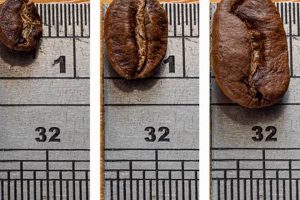
The quantity of coffee beans required for a standard serving of coffee is a foundational element in achieving the desired flavor profile. Typically, this measurement dictates the strength and overall taste experience. A common guideline suggests using approximately 70 coffee beans to produce a six-ounce cup of coffee, though variations exist based on bean density, grind size, and brewing method.
Precision in this measurement is paramount for consistency and cost control in commercial settings, and allows for replicable results when brewing at home. Historically, techniques for measuring coffee varied widely, often relying on imprecise estimations. Modern coffee preparation increasingly emphasizes the importance of accurate bean-to-water ratios, leading to more sophisticated measuring tools and brewing methods.
Understanding the relationship between bean quantity and the final cup is crucial for optimizing the brewing process. The following sections will delve into the specific factors influencing bean count, including bean type, grind size, and brewing methodology, exploring how each aspect contributes to the ultimate quality and characteristics of the brewed beverage.
Optimizing Coffee Brewing Through Bean Count
The following tips address optimization of the coffee brewing process through precise control of bean quantity, ensuring a consistent and high-quality final product.
Tip 1: Implement Weight-Based Measurement: Rather than relying on volume, use a scale to measure coffee beans. A standard ratio of coffee to water is often cited as 1:16 or 1:18 (coffee:water), but requires adjustment to fit individual preferences.
Tip 2: Adjust for Bean Density: Different coffee varieties possess varying densities. For instance, lighter-roasted beans are often less dense than darker roasts. Adjust the bean count accordingly to achieve the desired extraction level.
Tip 3: Optimize Grind Size for Brewing Method: The grind size significantly affects extraction. Finer grinds, used for espresso, require fewer beans by volume compared to coarser grinds for French press, where more contact time compensates for a smaller surface area.
Tip 4: Track Brewing Variables: Maintain a detailed record of bean count, water temperature, brewing time, and resulting taste. This data allows for fine-tuning of the brewing process to consistently replicate desired results.
Tip 5: Calibrate Equipment Regularly: Ensure that grinders and scales are properly calibrated. Inconsistent grind size or inaccurate weight measurements directly impact extraction and the ultimate flavor profile.
Tip 6: Consider the “Bloom” Phase: When brewing pour-over coffee, allow the ground coffee to “bloom” by saturating it with a small amount of hot water and allowing it to degas for approximately 30 seconds. Adjust subsequent water addition and bean quantity as needed to balance the extraction.
Tip 7: Experiment with Pre-Ground Options Cautiously: Pre-ground coffee loses its aroma and flavor more quickly than whole beans. If using pre-ground, carefully consider the initial grind size and adjust bean quantity upwards to compensate for any potential flavor degradation.
Implementing these tips allows for a more controlled and repeatable brewing process, resulting in consistently flavorful coffee.
The subsequent section will provide insight into frequently asked questions regarding coffee bean measurement and their impact on the final beverage.
1. Bean Density

Bean density, a fundamental characteristic of coffee beans, significantly influences the determination of the appropriate bean count for a desired cup of coffee. Variations in density impact the mass of coffee present in a given volume, thereby affecting extraction yield and ultimately the beverage’s strength and flavor profile.
- Impact on Mass Measurement
Denser beans possess a higher mass per unit volume than less dense beans. Therefore, a volumetric measurement of coffee beans will yield differing masses depending on the bean density. Using a consistent volume of less dense beans will result in a lower mass of coffee grounds, potentially leading to under-extraction and a weaker cup.
- Roast Level Influence
The roasting process significantly alters bean density. As beans roast, they lose moisture and expand, generally decreasing in density. Lighter roasts tend to be denser than darker roasts. This disparity necessitates adjustments to bean quantity to compensate for the density difference and maintain consistent coffee strength, when measuring by volume.
- Varietal and Origin Variations
Different coffee varietals and growing regions produce beans with varying inherent densities. Altitude, climate, and soil composition all contribute to bean density. Recognizing these variations is essential for precision in coffee brewing, especially in commercial settings where consistency is paramount. Adjustments to bean mass are required to optimize extraction for different origins.
- Effect on Grinding
Bean density affects the consistency of the grind. Denser beans may require a finer grind to achieve optimal extraction, while less dense beans may perform better with a coarser grind. Understanding this relationship ensures that the surface area exposed during brewing is maximized for the specific bean density, leading to a more balanced and flavorful cup.
In summary, accurate consideration of bean density is essential for determining the appropriate bean count and achieving a consistent and high-quality cup of coffee. Variations in density, influenced by roast level, origin, and varietal, necessitate adjustments to bean mass or volume to optimize extraction and ensure a balanced flavor profile. Failure to account for bean density can lead to under- or over-extraction, resulting in undesirable taste characteristics.
2. Grind Size

Grind size is a critical variable intertwined with the quantity of coffee beans required for optimal brewing. The fineness or coarseness of the coffee grounds directly influences the extraction rate and, consequently, the ideal bean-to-water ratio for a given brewing method.
- Surface Area and Extraction Rate
Finer grinds create a larger surface area exposed to the water, accelerating the extraction of soluble compounds. This increased surface area allows for more efficient extraction, potentially requiring fewer beans to achieve the desired strength and flavor profile. Conversely, coarser grinds present a smaller surface area, necessitating more beans or a longer brewing time to extract the same amount of soluble compounds.
- Brewing Method Compatibility
Different brewing methods demand specific grind sizes. Espresso requires a very fine grind to maximize extraction under pressure, while a French press benefits from a coarser grind to prevent over-extraction and the passage of sediment through the filter. Selecting an inappropriate grind size for a given method can result in either weak, sour coffee (under-extraction) or bitter, muddy coffee (over-extraction), regardless of the bean quantity used.
- Contact Time and Water Flow
Grind size also affects water flow during brewing. Fine grinds can impede water flow, leading to uneven extraction and potentially clogging filters. Coarser grinds allow for faster water flow, which can reduce contact time and result in under-extraction if the bean quantity is not adjusted accordingly. The ideal grind size balances water flow and contact time to ensure uniform extraction across the coffee bed.
- Impact on Flavor Profile
The grind size influences the extraction of different flavor compounds from the coffee beans. Finer grinds tend to extract acids and bitter compounds more readily, while coarser grinds favor the extraction of sweeter and more balanced flavors. The bean quantity must be optimized in conjunction with the grind size to achieve the desired balance of acidity, sweetness, and bitterness in the final cup.
In summary, the selection of an appropriate grind size is inseparable from the determination of the optimal bean quantity. These factors must be carefully considered in tandem to achieve the desired extraction yield and flavor profile for a given brewing method. Ignoring this interplay can lead to inconsistent results and a suboptimal coffee experience, regardless of the quality of the beans themselves.
3. Brewing Method
The selection of a brewing method exerts a significant influence on the determination of the quantity of coffee beans required to achieve a desirable extraction yield and flavor profile. Different brewing techniques necessitate varying coffee-to-water ratios and grind sizes, directly impacting the optimal bean count. For instance, immersion methods such as the French press, where coffee grounds are steeped in water for an extended period, typically require a coarser grind and a higher bean-to-water ratio compared to pressure-driven methods such as espresso. The longer contact time in immersion methods allows for greater extraction, necessitating adjustments to the bean quantity to prevent over-extraction and bitterness. Conversely, espresso, with its short extraction time and high pressure, relies on a fine grind and a relatively lower bean-to-water ratio to achieve a concentrated and flavorful shot.
Pour-over methods, such as V60 or Chemex, offer a more nuanced control over the brewing process, allowing for adjustments to water flow, temperature, and bloom time. This greater control necessitates a more precise understanding of the relationship between bean quantity and extraction. An insufficient quantity of beans can lead to under-extraction, resulting in a weak and sour cup, while an excessive quantity can cause over-extraction, yielding a bitter and astringent taste. Automatic drip machines, while often considered less precise, still require careful consideration of bean quantity to ensure a balanced brew. Overfilling the filter basket can lead to channeling and uneven extraction, while using too little coffee can result in a weak and watery beverage. The proper water temperature is also necessary to maximize the results for extraction.
In conclusion, the brewing method serves as a primary determinant in the optimization of bean quantity. Understanding the specific requirements of each method, including grind size, water temperature, contact time, and flow rate, is crucial for achieving a consistent and high-quality cup of coffee. Ignoring these factors can lead to inconsistent results and a suboptimal coffee experience, regardless of the quality of the beans used. Therefore, a methodical approach to brewing, tailored to the chosen method and bean characteristics, is essential for maximizing the potential of the coffee.
4. Desired Strength

The desired strength of the brewed coffee is directly proportional to the quantity of coffee beans employed. A stronger cup, characterized by a more intense flavor and higher concentration of soluble solids, necessitates a greater mass of coffee beans relative to the volume of water. Conversely, a weaker cup, with a milder flavor and lower concentration, requires a smaller mass of beans. This relationship stems from the fundamental principle of extraction, wherein soluble compounds are dissolved from the coffee grounds into the water. A higher bean count provides a greater reservoir of these compounds, resulting in a stronger brew. For example, a cafe seeking to produce a robust espresso may use 20 grams of finely ground coffee beans, while a milder drip coffee might utilize only 10 grams for a similar volume of water. The perceived strength is determined by the Total Dissolved Solids (TDS). The TDS of an under extracted shot of espresso will give you a weak taste, and under-developed crema.
The practical application of this understanding is evident in various coffee preparation scenarios. In home brewing, individuals adjust the bean quantity based on personal preferences for strength. Commercial establishments, such as coffee shops and restaurants, calibrate their brewing parameters, including bean quantity, to ensure consistency in the strength of their coffee offerings. This consistency is essential for customer satisfaction and brand reputation. Coffee strength is sometimes mistaken for the roast level of the bean. More inexperienced drinkers find a darker roast bean to have a bolder flavor which is mistaken for more caffeine and strength. In reality the roast is less of a factor as grind size, brewing method and extraction can play more of a factor.
In summary, the desired strength is a critical determinant of coffee bean quantity. Achieving the targeted strength requires a careful balancing of bean mass, grind size, water temperature, and brewing time, all tailored to the specific brewing method. While challenges may arise due to variations in bean density and individual taste preferences, a clear understanding of this relationship is fundamental to consistently producing coffee of the desired strength and quality. In addition to quality and bean type, TDS readers are a more accurate reading of caffeine and strength.
5. Roast Level

The roast level of coffee beans exerts a notable influence on the optimal quantity used for a given cup. This relationship arises from the alterations in bean density, moisture content, and cellular structure that occur during the roasting process. Lighter roasts, characterized by a shorter roasting time and lower internal bean temperature, retain more moisture and exhibit a higher density compared to darker roasts. Consequently, a volumetric measurement of light roast beans will contain a greater mass of coffee compared to the same volume of dark roast beans. This difference necessitates adjustments to bean quantity to achieve a consistent strength and flavor profile, when using volume-based measurement.
Darker roasts, subjected to higher temperatures and longer roasting durations, undergo significant structural changes. The beans become more porous, lose mass, and exhibit a more pronounced aroma and flavor profile. While the flavor intensity increases, the overall mass of coffee beans required to achieve the desired strength may decrease, especially when utilizing weight-based measurement. For instance, when brewing a French press, a user might find they need slightly less of a dark roast bean versus a blonde roast. The dark roast bean in this scenario would taste bitter, and the blonde roast being lower TDS can result in weaker, less flavorful coffee if they didn’t use enough beans to begin with.
In summary, the roast level affects bean density and flavor concentration, thereby influencing the quantity of coffee beans needed for a balanced brew. Lighter roasts typically require a slightly higher bean mass to compensate for their greater density, while darker roasts, despite their lower density, may require adjustments to account for their more intense flavor profile. Recognizing this interplay ensures a more controlled and consistent brewing process, leading to the final targeted product of the brewing process.
6. Extraction Yield

Extraction yield, representing the percentage of soluble solids extracted from ground coffee beans during brewing, is fundamentally linked to the determination of the appropriate bean quantity. Understanding this connection is crucial for optimizing flavor, minimizing waste, and ensuring consistency in coffee preparation.
- Target TDS and Bean Mass
A specific Total Dissolved Solids (TDS) level is often targeted to achieve a desired cup strength and flavor profile. Achieving this target requires a precise bean-to-water ratio, with the bean mass directly impacting the extraction yield. Insufficient bean mass will result in under-extraction, producing a weak and sour cup, while excessive mass can lead to over-extraction, yielding a bitter and astringent brew. Professional baristas will taste the resulting extraction and make changes accordingly for each cup.
- Grind Size and Extraction Efficiency
Grind size influences the surface area exposed to water, thereby affecting the efficiency of extraction. Finer grinds result in faster extraction, potentially requiring fewer beans to achieve the target TDS. Coarser grinds, with a smaller surface area, necessitate more beans or a longer brewing time to achieve the same extraction yield. A grind too coarse will result in sour coffee. A grind too fine will result in a bitter, astringent tasting coffee.
- Brewing Method and Extraction Control
Different brewing methods offer varying degrees of control over the extraction process. Immersion methods, like French press, allow for extended contact time, leading to higher extraction yields, while pour-over methods provide more nuanced control over flow rate and saturation, influencing the final extraction. The bean quantity must be adjusted in accordance with the chosen brewing method to optimize extraction and avoid under- or over-extraction.
- Roast Level and Solubility
The roast level influences the solubility of coffee compounds. Darker roasts are generally more soluble, requiring less bean mass to achieve the same extraction yield compared to lighter roasts. Adjusting the bean quantity based on the roast level ensures that the desired TDS is reached without compromising the flavor profile. Lighter roasts are more dense, resulting in a need for more beans during the brewing process.
The principles of extraction yield are crucial in determining an appropriate number of beans per cup, as exemplified by baristas adjusting their bean measurement based on tasting and brewing habits. Inconsistent mass of beans for a cup, resulting from inattention to roast, bean mass, grind size and TDS measurements, can result in poor tasting coffee. The careful optimization of these extraction factors ensures a delicious, effective brew.
Frequently Asked Questions
This section addresses common inquiries regarding the appropriate number of coffee beans to use per cup, providing clarity and practical guidance.
Question 1: Is there a universally applicable “how many coffee beans in a cup” guideline?
No, a single standard does not exist. The ideal quantity varies depending on bean density, grind size, brewing method, and desired strength. A starting point is approximately 70 coffee beans for a six-ounce cup, but experimentation is necessary.
Question 2: Does the roast level impact “how many coffee beans in a cup” are needed?
Yes, roast level affects bean density. Lighter roasts are generally denser than darker roasts. Therefore, a slightly greater volume of light roast beans might be needed compared to dark roast beans, when measuring volumetrically, to achieve similar strength.
Question 3: How does the grind size relate to “how many coffee beans in a cup” should be used?
Finer grinds extract more efficiently, potentially requiring fewer beans. Coarser grinds necessitate more beans or longer brewing times. The grind size must be appropriate for the chosen brewing method to optimize extraction.
Question 4: What measurement method is best for determining “how many coffee beans in a cup” to use?
Weight-based measurement using a scale is generally more accurate and consistent than volumetric measurement. Weighing allows for precise control over the mass of coffee beans used, regardless of density variations.
Question 5: Does the type of coffee bean affect “how many coffee beans in a cup” are required?
Yes, different coffee varieties possess varying densities and flavor profiles. Experimentation is crucial to determine the ideal bean quantity for specific varieties, considering factors such as acidity, body, and aroma.
Question 6: How does brewing method affect “how many coffee beans in a cup” are used?
Brewing methods that increase the contact time between water and coffee grounds require fewer beans to get results. Other methods, such as drip machines, may require more beans. Experimentation is key for brewing methods to determine if an adjustment should be made.
Achieving consistent coffee quality requires a thoughtful approach to bean quantity, considering multiple variables. Experimentation and precise measurement are essential for dialing in the ideal brewing parameters.
The subsequent section will summarize the core principles discussed and offer concluding thoughts.
Conclusion
The exploration of the “how many coffee beans in a cup” question has revealed a complex interplay of factors that influence the final beverage. Bean density, grind size, brewing method, desired strength, roast level, and extraction yield all contribute to determining the optimal bean quantity. Precision in measurement, adaptation to specific bean characteristics, and careful consideration of brewing variables are essential for achieving consistent and high-quality results.
Mastering the art of coffee preparation necessitates a commitment to understanding these principles and refining brewing techniques. Continued experimentation and meticulous attention to detail will enable coffee enthusiasts and professionals alike to unlock the full potential of their chosen beans, ensuring a consistently satisfying coffee experience and promoting an appreciation for the subtleties of this widely enjoyed beverage.


![Perky Beans Coffee & PB Cafe Menu: Your [Tasteful] Guide | The Ultimate Coffee Guide: Types, Brewing Methods & Best Beans](https://deacoffee.com/wp-content/uploads/2026/05/th-88-300x200.jpg "Perky Beans Coffee & PB Cafe Menu: Your [Tasteful] Guide The Ultimate Coffee Guide: Types, Brewing Methods & Best Beans")