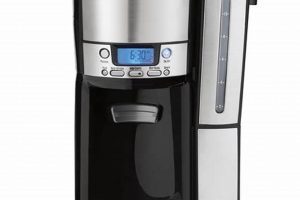
A specialized brewing apparatus, typically constructed of stainless steel and glass, utilizes a slow, gravity-fed process to extract concentrated coffee essence from coarsely ground beans. This equipment is designed for high-volume output, catering to the demands of cafes, restaurants, and other foodservice establishments. Its design prioritizes consistent extraction and ease of cleaning for repeated daily use.
These systems yield a beverage characterized by its low acidity, smooth flavor profile, and extended shelf life compared to traditionally brewed coffee. This method originated from historical cold brewing techniques, evolving into contemporary designs that offer precise control over drip rate and extraction time. The resulting concentrate can be used as a base for various cold coffee beverages, enhancing menu versatility and appealing to consumers seeking a milder, less bitter coffee experience.
The subsequent sections will delve into the operational principles, maintenance requirements, and considerations for selecting appropriate equipment to meet specific operational needs within a commercial environment. Further exploration will cover brewing variables, yield optimization, and the impact of coffee origin on the final product.
Optimizing Performance
Efficient operation of the target equipment requires adherence to best practices, ensuring consistent beverage quality and maximizing equipment lifespan.
Tip 1: Grind Size Optimization: Consistent coarse grind is critical. Uniform particle size promotes even water saturation and prevents channeling, resulting in balanced extraction and preventing bitter over-extraction.
Tip 2: Precise Drip Rate Control: Fine-tune the drip rate according to coffee origin and roast level. Slower drip rates generally enhance extraction for lighter roasts, while faster rates may be suitable for darker roasts to prevent over-extraction.
Tip 3: Water Quality Management: Employ filtered water with consistent mineral content. Impurities and excessive minerals can negatively impact flavor profile and potentially damage components within the equipment.
Tip 4: Regular Cleaning Protocols: Implement a rigorous cleaning schedule to prevent coffee oil buildup and bacterial growth. Disassemble and clean all components after each use, paying particular attention to the drip nozzles and reservoirs.
Tip 5: Consistent Coffee Bean Sourcing: Maintain consistency in coffee bean origin, roast level, and freshness. Variations in these factors will significantly impact the final product, necessitating adjustments to the brewing parameters.
Tip 6: Temperature Monitoring: While the process is cold, ambient temperature can still influence extraction. Maintain a stable ambient temperature to ensure predictable brewing outcomes. Record temperature fluctuations and adjust brewing parameters accordingly.
Tip 7: Calibration and Maintenance: Regularly calibrate the drip rate control mechanism and inspect all components for wear and tear. Promptly replace any damaged or worn parts to maintain optimal performance and prevent potential breakdowns.
Consistent application of these techniques will result in consistently high-quality beverage production, reduced waste, and extended equipment longevity.
The concluding section will provide guidance on selecting appropriate equipment based on production volume and operational requirements.
1. Extraction Efficiency

Extraction efficiency, in the context of the target coffee brewing equipment, refers to the percentage of soluble solids removed from the coffee grounds during the brewing process. Maximizing this efficiency is paramount for commercial viability, influencing both the quality and the cost-effectiveness of the final product.
- Surface Area Optimization
The grind size of the coffee significantly impacts the surface area exposed to the water. Coarser grinds, as typically used, allow for more controlled and even extraction, minimizing the risk of over-extraction and bitter flavors. Balancing grind size with drip rate is essential for optimal soluble solid removal.
- Water Saturation and Contact Time
Complete and consistent saturation of the coffee grounds ensures that all available solubles are dissolved. The prolonged contact time characteristic of this method allows for thorough extraction, but it also necessitates careful monitoring to prevent undesirable compounds from being extracted. Adjusting the drip rate regulates contact time and, consequently, the profile of the final concentrate.
- Solvent Capacity of Water
The properties of the water itself its temperature, purity, and mineral content affect its ability to dissolve coffee solubles. While the process operates at ambient temperatures, the water’s inherent dissolving capacity remains crucial. Filtered water with a balanced mineral composition enhances extraction, avoiding both under-extraction due to insufficient mineral content and unwanted flavors from excessive mineral content.
- Concentrate Yield Optimization
The ultimate measure of extraction efficiency is the yield of concentrated extract per unit of coffee grounds. Higher yields translate directly to lower per-serving costs, boosting profit margins. Careful optimization of the aforementioned factors allows for maximizing yield without compromising the quality and flavor characteristics of the final beverage.
In summary, optimizing extraction efficiency in target brewing equipment necessitates a holistic approach. This involves carefully controlling grind size, water saturation, contact time, and water quality. Balancing these factors results in a high-yield, high-quality concentrate that contributes significantly to the financial success of any commercial operation utilizing the target coffee extraction method.
2. Brewing Consistency
Brewing consistency is a critical attribute of any target coffee brewing system operating in a commercial setting. Fluctuations in beverage strength, flavor profile, or overall quality can negatively impact customer satisfaction and brand reputation. The equipment, by its inherent design, facilitates consistent brewing through precise control of several key variables. Drip rate regulation, coupled with the use of consistent grind size and water temperature, minimizes variations in extraction. Furthermore, the equipment’s durable construction and repeatable processes reduce the likelihood of mechanical errors influencing the final product. An example lies in the use of calibrated valves to maintain the drip rate across multiple batches. Deviations necessitate immediate attention. This commitment to precision ensures that each beverage adheres to a standardized flavor profile, fostering consumer trust and reliability.
The practical significance of brewing consistency extends beyond customer perception. Consistent production allows for accurate inventory management and cost control. Predicting the yield of concentrate per batch allows for optimized resource allocation and minimizes waste. Furthermore, consistent extraction reduces the need for constant adjustments to recipes or blending procedures, streamlining operations and minimizing labor costs. A consistently extracted concentrate, for instance, allows for predictable dilution ratios when crafting final beverages, simplifying the barista’s task and reducing the possibility of errors. A notable example would be a coffee shop chain using precisely calibrated equipment to provide identical cold brew flavor across multiple locations. This consistency becomes a defining feature of the brand.
Maintaining consistent brewing with the target coffee equipment involves proactive measures such as regular cleaning, component inspection, and adherence to standardized procedures. Despite the equipment’s inherent design advantages, deviations can occur if these maintenance requirements are neglected. Consistency checks are crucial to early problem detections, as are regular training sessions that help prevent or minimize human error. While achieving absolute uniformity is difficult, striving for minimal variation within acceptable tolerances is essential for commercial success and long-term brand value. The combination of technologically sound equipment, diligent maintenance, and disciplined operational practices makes the method a reliable choice for businesses where consistent product quality is paramount.
3. Operational Scalability

Operational scalability, in the context of equipment under consideration, refers to its capacity to adapt production volume in response to fluctuating demand. The architecture of such systems impacts the ease with which a business can adjust output without significant capital investment or operational disruption. Capacity expansion can be achieved through several strategies, including the acquisition of additional units, the utilization of larger-capacity brewing vessels, or optimized scheduling of brewing cycles. The degree to which a specific system facilitates these adjustments directly influences its suitability for businesses experiencing variable customer flow or anticipated periods of rapid growth. Systems designed with modularity in mind, allowing for incremental increases in production, offer a distinct advantage over those requiring complete system replacement for even moderate increases in output.
Examining real-world applications reveals the importance of considering operational scalability during equipment selection. A small-scale cafe, for example, might initially employ a single, mid-sized unit to meet daily demand. As popularity grows and customer volume increases, the business could add a second unit to double production capacity without disrupting existing workflows or requiring significant staff retraining. Conversely, a large-scale coffee roasting facility intending to enter the cold brew market might opt for a system with multiple, interconnected brewing modules, allowing for significant scaling of production to meet initial demand and future growth projections. Understanding the scalability of the equipment, therefore, becomes a key factor in aligning capital investment with projected revenue and operational needs. Systems lacking scalability may constrain growth potential or necessitate premature equipment replacement, resulting in unnecessary costs and operational inefficiencies.
In summary, operational scalability constitutes a critical component of the target coffee brewing equipment, particularly for businesses operating in dynamic market conditions. Equipment selection should prioritize systems capable of adapting to fluctuating demand without incurring excessive capital expenditure or operational overhead. Assessing the scalability features of available options, considering potential growth scenarios, and aligning equipment capacity with long-term business objectives contribute to efficient resource utilization and sustainable business growth. Failure to adequately address this aspect can lead to operational bottlenecks, missed revenue opportunities, and ultimately, reduced profitability.
4. Material Durability
Material durability is paramount in commercial coffee brewing equipment, particularly within the context of systems, due to the demands of high-volume, repetitive usage. The selection of robust, food-grade materials directly impacts the equipment’s lifespan, maintenance requirements, and overall cost-effectiveness. Inadequate material selection can lead to premature failure, contamination risks, and increased operational downtime.
- Stainless Steel Composition
The grade and treatment of stainless steel components constitute a primary determinant of durability. High-quality stainless steel, such as 304 or 316, exhibits superior corrosion resistance and structural integrity under prolonged exposure to water, coffee oils, and cleaning agents. Inferior stainless steel grades are susceptible to pitting, rust, and weakening of structural joints, ultimately shortening the equipment’s usable lifespan. For example, a system employing 316 stainless steel for its reservoir will exhibit greater resistance to chloride-induced corrosion than one constructed with 201 stainless steel, particularly in environments with hard water.
- Glass Integrity and Thermal Shock Resistance
Glass components, such as reservoirs and drip towers, require exceptional thermal shock resistance to withstand repeated temperature fluctuations during cleaning and operation. Borosilicate glass, known for its low thermal expansion coefficient, minimizes the risk of cracking or shattering due to rapid temperature changes. The thickness and tempering process of the glass also contribute to its overall strength and resistance to impact damage. Thin-walled glass reservoirs, in contrast to thicker, tempered glass, are more prone to fracture under pressure or sudden temperature shifts, necessitating frequent replacements.
- Seal Material Properties
Seals and gaskets are essential for maintaining watertight connections and preventing leaks within the system. The material composition of these seals, typically silicone or rubber compounds, must exhibit resistance to degradation from exposure to coffee oils, cleaning chemicals, and prolonged compression. Inferior seal materials may become brittle, cracked, or deformed over time, leading to leaks and inefficient operation. High-quality silicone seals, designed to withstand high temperatures and chemical exposure, maintain their elasticity and sealing properties for extended periods, reducing maintenance frequency.
- Frame and Support Structure Robustness
The frame and support structure provide the foundation for the entire system, bearing the weight of the components and withstanding vibrations during operation. The materials used in the frame, typically stainless steel or reinforced polymers, must possess sufficient strength and rigidity to prevent bending, warping, or collapse under load. A robust frame ensures the alignment and stability of the brewing components, minimizing the risk of leaks and ensuring consistent drip rates. Lightweight or poorly constructed frames are susceptible to distortion, compromising the equipment’s functionality and longevity.
In conclusion, a comprehensive understanding of material properties and their influence on durability is crucial for selecting reliable equipment. Prioritizing equipment constructed with high-quality, food-grade materials, resistant to corrosion, thermal shock, and chemical degradation, ensures a longer operational lifespan, reduced maintenance costs, and consistently high-quality brewing performance.
5. Maintenance Requirements

The operational longevity and performance consistency of the target brewing equipment are directly contingent upon adherence to a rigorous maintenance schedule. Neglecting routine maintenance procedures can lead to decreased extraction efficiency, compromised beverage quality, and ultimately, equipment failure.
- Cleaning Protocols for Coffee Oil Buildup
Coffee oils accumulate on internal surfaces of the equipment, impeding water flow and potentially harboring bacteria. Regular cleaning with food-grade detergents is essential for removing these residues. Disassembly of components, such as drip nozzles and reservoirs, facilitates thorough cleaning and prevents the formation of biofilms. Failure to address coffee oil buildup can result in bitter flavors and inconsistent extraction rates.
- Inspection and Replacement of Seals and Gaskets
Seals and gaskets maintain watertight connections throughout the system, preventing leaks and ensuring consistent drip rates. These components are subject to wear and tear from repeated compression and exposure to water and coffee oils. Periodic inspection for cracks, brittleness, or deformation is necessary. Replacement of damaged seals prevents water loss, maintains brewing consistency, and avoids potential damage to other components due to leaks.
- Descaling Procedures for Mineral Deposits
Water hardness contributes to the buildup of mineral deposits within the equipment, particularly in heating elements and water lines. These deposits impede water flow, reduce heating efficiency, and can ultimately cause component failure. Regular descaling with appropriate descaling solutions removes mineral buildup, maintaining optimal equipment performance and prolonging its lifespan. Frequency of descaling depends on local water hardness levels.
- Calibration of Drip Rate Controls
Precise drip rate control is crucial for consistent extraction and repeatable brewing results. The drip rate control mechanism is subject to drift over time due to mechanical wear or external factors. Regular calibration using calibrated flow meters ensures accurate drip rates, maintaining brewing consistency and preventing over- or under-extraction. Failure to calibrate drip rate controls can lead to variations in beverage strength and flavor profile.
Effective implementation of these maintenance practices ensures that the equipment operates reliably, producing consistent, high-quality beverages while minimizing the risk of costly repairs or premature equipment replacement. Consistent adherence to a preventative maintenance schedule translates directly into increased profitability and enhanced customer satisfaction.
Frequently Asked Questions
The following addresses common inquiries regarding the functionality, operation, and selection of commercial cold drip coffee makers. The aim is to provide clarity and dispel potential misconceptions surrounding the apparatus and its application within a commercial context.
Question 1: What distinguishes this brewing method from immersion-based cold brew?
The primary distinction lies in the extraction methodology. This method employs a slow, gravity-fed drip, allowing for prolonged and controlled water-coffee contact. Immersion methods, conversely, steep coffee grounds in water for an extended period. The drip system typically yields a cleaner, more nuanced flavor profile with reduced sediment.
Question 2: Is temperature control a factor in the brewing process?
While the method is inherently a cold-brewing process, ambient temperature fluctuations can influence extraction rates. Maintaining a stable ambient temperature is advisable for achieving consistent results. However, active temperature regulation of the water itself is not a standard feature or requirement.
Question 3: How frequently should a commercial cold drip coffee maker be cleaned?
Thorough cleaning after each brewing cycle is recommended. This practice prevents the buildup of coffee oils and minimizes the risk of bacterial growth. Disassembly of components, such as drip nozzles and reservoirs, facilitates comprehensive cleaning.
Question 4: What grind size is optimal for this equipment?
A coarse grind is generally recommended. This allows for even water saturation and prevents channeling, promoting balanced extraction and mitigating the risk of over-extraction and bitter flavors.
Question 5: What type of water filtration system is advised for use with this equipment?
Employing a water filtration system that removes chlorine, sediment, and excessive mineral content is beneficial. Consistent water quality is crucial for optimal extraction and the prevention of mineral scale buildup within the system.
Question 6: What is the typical concentrate-to-water ratio for serving the final beverage?
The ideal concentrate-to-water ratio varies according to individual taste preferences. A starting point of 1:2 or 1:3 (concentrate to water) is generally recommended, with adjustments made to achieve the desired strength and flavor profile.
In summary, these FAQs address critical aspects of using target coffee brewing equipment, from fundamental differences between brewing methods to essential maintenance procedures. Adhering to these guidelines ensures optimal performance, consistent beverage quality, and prolonged equipment lifespan.
The subsequent section will explore case studies of businesses successfully implementing the equipment into their coffee preparation processes.
Conclusion
The preceding sections have systematically explored the operational principles, maintenance requirements, and selection criteria relevant to commercial cold drip coffee maker systems. Key aspects addressed include optimizing extraction efficiency through controlled grind size and drip rate, ensuring brewing consistency for repeatable product quality, and understanding material durability to maximize equipment lifespan. Furthermore, the necessity of rigorous cleaning and calibration schedules has been underscored to maintain optimal performance and minimize operational disruptions. The functionality of the equipment rests on consistently performing these elements.
Ultimately, informed decision-making regarding capital investment in a commercial cold drip coffee maker necessitates a comprehensive understanding of its operational characteristics and maintenance needs. Such systems represent a strategic investment for businesses prioritizing consistent, high-quality beverage production and operational scalability. Diligent consideration of the factors outlined herein will contribute to maximizing return on investment and ensuring long-term operational success. The future outlook is positive for this methodology as consumers are looking for coffee with complex notes.

![Best 12 Cup Programmable Coffee Maker [Guide & Reviews] | The Ultimate Coffee Guide: Types, Brewing Methods & Best Beans](https://deacoffee.com/wp-content/uploads/2026/04/th-268-300x200.jpg "Best 12 Cup Programmable Coffee Maker [Guide & Reviews] The Ultimate Coffee Guide: Types, Brewing Methods & Best Beans")